
Living in hope in the footsteps of Angela
02/06/2026
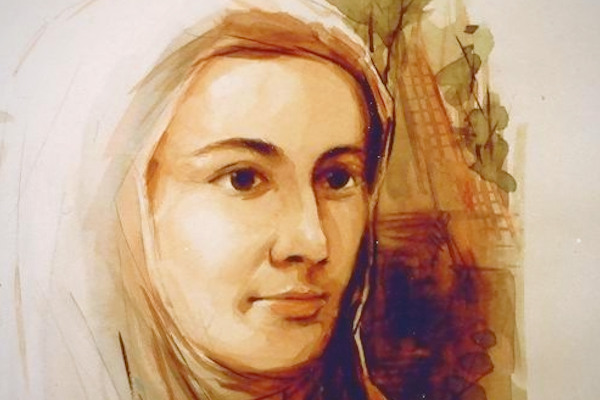
« Love your dear daughters equally;
and do not prefer one more than another,
because they are all creatures of God.
And you do not know what he wants to make of them. »
(Eighth Counsel)
Angela is born into a world marked by uncertainty, tensions, and fragility — a world that resembles our own, shaped by rapid changes and ongoing transformations.
And yet, in the midst of all this, she develops a way of hoping that has nothing abstract about it: a very simple way of living everyday life, relationships, and responsibilities. This hope is deeply rooted in her faith, in her relationship with Christ.
To enter into Angela’s understanding of hope, three movements are proposed to us, based on three sentences quoted from her writings, which we will discover later.
The first movement is the gaze: a gaze that recognises the value of the other, even when it is discreet or fragile.
The second movement is action: a humble, well adjusted action that does what is possible today, with just what one has, without waiting to have all the means or all the answers.
The third movement is transmission: a handing on that takes place through a way of doing things, traces of which can be found in the writings and in the lives of those who have followed Angela, from yesterday to today.
We will move forward gently, drawing on a few words of Angela, and allow each of them to shed light on some aspect of our lives. These writings of Angela are not isolated sayings: they form a dynamic that transforms relationships and our way of relating to the world.
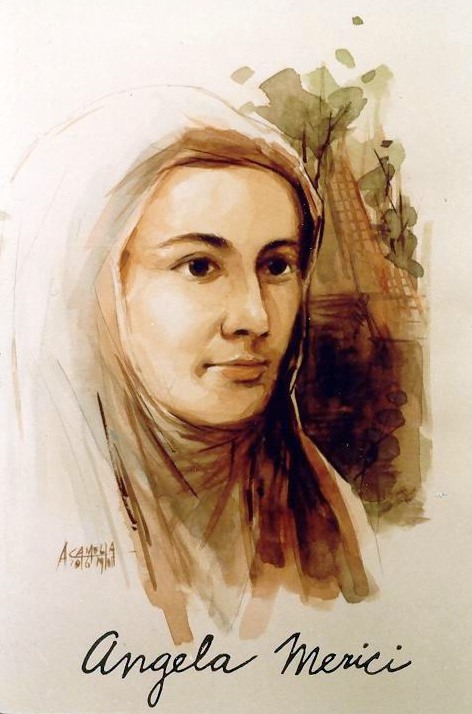 Hope begins with a gaze.
A gaze offered with tenderness, that does not seek to grasp or take hold, but simply allows things to be. A gaze that sees beyond what is visible, that recognises value even when it does not show itself.
This hopeful gaze is a way of standing before the other: looking not at what they show, but at what they carry within. A gaze that does not stop at what is lacking, but makes room for what can come into being. For Angela, to hope is first of all to believe that within each person there remains a value that does not disappear, even when it is hidden, fragile, or difficult to see. This gaze is already an act of hope: it allows the other to breathe, does not confine them to a single act, and creates the conditions for the relationship to be renewed.
That is precisely the gaze that opens up the relationship, particularly in an educational context.
Hope in Angela, as in the Bible, becomes real when it takes shape in a gesture, when it sets in motion the one who carries it. It is a way of moving forward in the reality of our lives, of setting out without waiting for everything to be clear. It is about doing what is possible today. And often, it is this very step that helps us stand up again.
“Act, move, believe, strive, hope…” (Counsels, Prologue 17)
This is not a programme. It is an invitation to move forward that calls upon faith and determination, and which takes the form of a journey, without knowing where it will lead, simply letting oneself be carried along by what calls. Many biblical passages invite us to set out under these same conditions, without understanding everything: the Visitation, the departure of the Magi, the healing of the ten lepers, or finally that beautiful passage from the Epistle to the Hebrews 11:8… The path takes shape as we go. It is on this path that hope is received and made real. Angela, sensitive to Scripture, fully grasped this movement.
Hope, then, is not something to be possessed, but a consent. A way of saying yes to the life that calls us. And once our gaze has opened up a space, once we have set out on the journey, another attitude embodies hope: passing it on. Not mere words, but a flow of life. A letting go of what is to come, with great trust in God: “And above all: to obey the counsels and inspirations which the Holy Spirit unceasingly sends into our hearts” (Rule 8, 14)
A word spoken at just the right moment, a presence that remains, a gesture that offers support. It is not a matter of passing on knowledge, but of instilling trust: trust in life, in relationships, in God. To pass something on is to accept that we cannot see everything. It is to sow without knowing whether it will sprout, or how it will sprout. It is also knowing when to step aside so that the other person can take their place.
Transmission is never conceived as a plan. It is neither organised nor structured like an expansion project. Rather, it appears as a flow of life.
When we look at what happened after Angela’s death, we see something astonishing: a rapid, unpredictable expansion that is almost impossible to explain through human strategies. Ordinary women, often without resources, carried her vision to cities, then to countries, then to other continents. At first, they had neither power, nor structures, nor political support. They had only a way of being, a way of connecting with others, a way of hoping.
Thus, Angela's hope is not fragile; it is deeply rooted.
It is a way of holding on to life, a way of withstanding the harshness of the world, a way of believing that life can still flow—here, now, through us. It is also a way of answering the call of the Spirit: “And above all: to obey the counsels and inspirations which the Holy Spirit unceasingly sends into our hearts” (Rule 8:14)
D.G.
Dominique Garnier - the training coordinator at the Angela Merici Centre
("Mericens en Lien" - Bulletin of the Merician Family, France-Belgium-Spain Province,
February–March 2026, No. 2, p. 6-7)